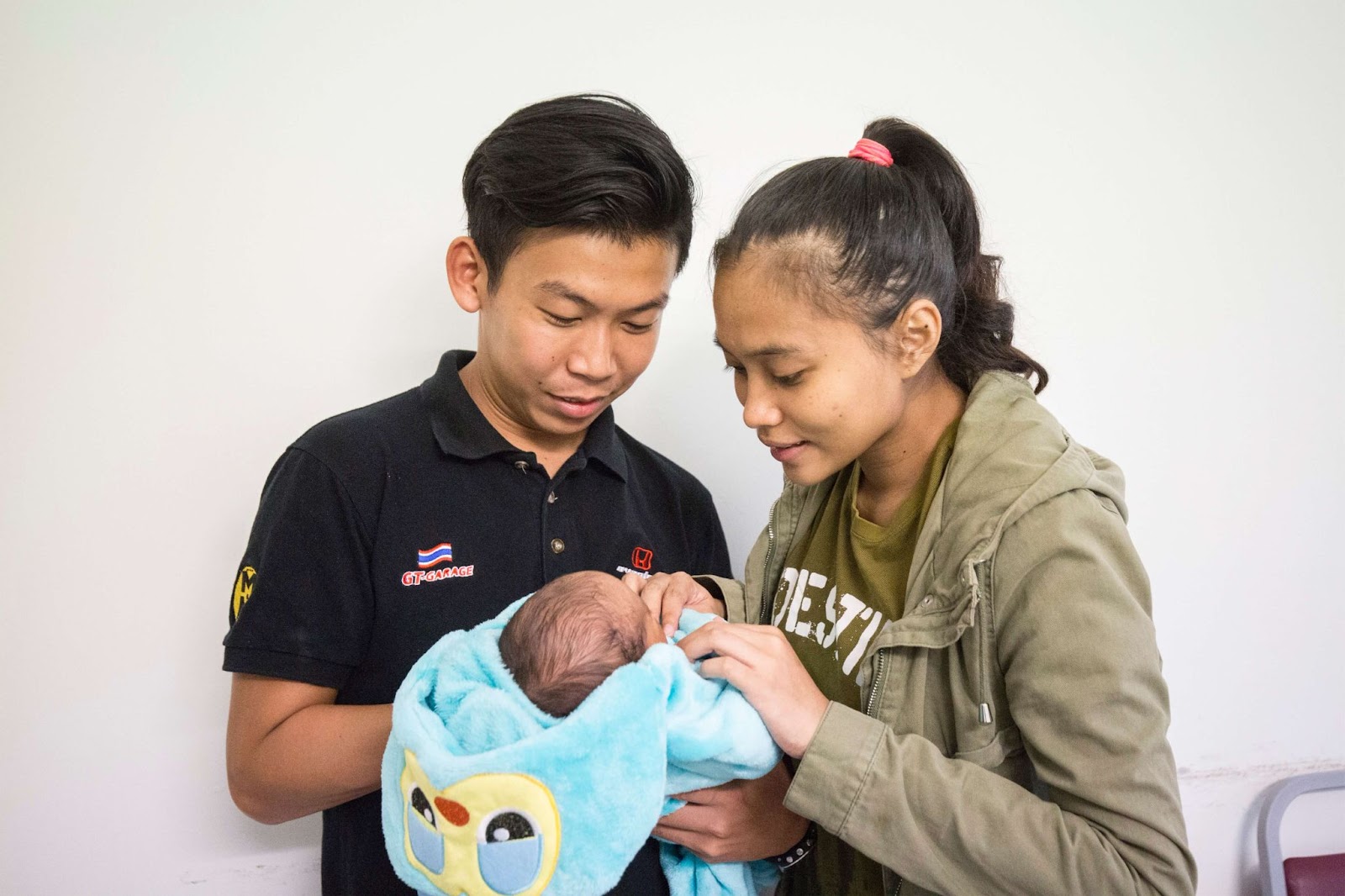
Access to safe, effective, quality, affordable, and acceptable contraceptive information and services, together with the prevention and treatment of infertility, allows people to have the number and timing of children they would like.
Ensuring access to preferred contraceptive methods for women and couples is essential to securing their well-being and autonomy, while supporting the health and development of communities. Evidence shows that in 2019, amongst the 1.9 billion women of reproductive age (15–49 years) worldwide, 270 million have an unmet need for contraception. Some women and girls face particular challenges – less than half of the need for family planning was met in Middle and Western Africa. Reasons for this include: fear or experience of side effects, limited access and choice, cultural or religious opposition, and poor quality of available services. Satisfying the demand for contraception would significantly reduce unintended pregnancies, unplanned births and induced abortions, as well as maternal morbidity and mortality; some forms of contraception can also help prevent transmission of sexually transmitted infections (STIs), including HIV.
Infertility affects millions of people globally, the vast majority of whom cannot access the essential interventions they need for various reasons. Despite the scale of infertility and its negative consequences for individuals, couples, families and communities, fertility care is a neglected area of policy, programming and research. HRP is in a unique position to provide global leadership on fertility care, helping people to fulfil their right to procreate.


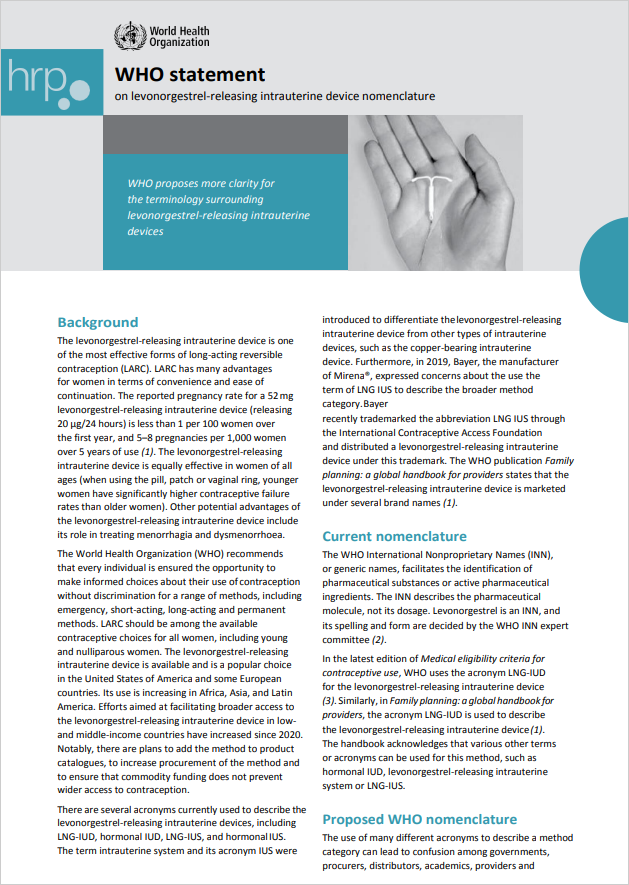
Consistency in contraceptive naming or nomenclature supports country efforts to introduce a variety of methods and help ensure adequate supplies and an understanding of the differences between similar methods. It has been recognised, however, that many different acronyms are currently being used for the category of levonorgestrel-releasing intrauterine device methods. This is of concern as it leads to confusion among governments, procurers, distributors, academics, providers and users. WHO and HRP therefore released a statement on levonorgestrel-releasing intrauterine device nomenclature, highlighting the importance of selecting and ensuring alignment with a single term. WHO will continue to use the term levonorgestrel-releasing intrauterine device in existing guidelines; in the future, however, the terms hormonal IUD (as a category) and levonorgestrel-releasing IUD (as the specific method) will be used in WHO guidelines.
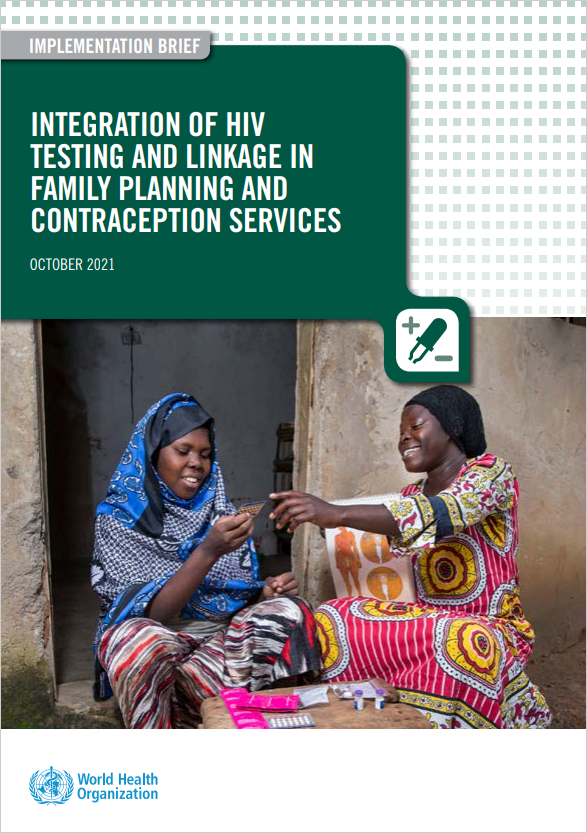
Through a collaboration between USAID, Johns Hopkins University, and HRP, two new chapters of the 2018 Global handbook for family planning providers have now been published. The two chapters address providing contraceptive services for adolescents and for women at high risk of HIV, and providing family planning services during an epidemic. These chapters draw on recently issued WHO guidance regarding: a) contraceptive medical eligibility for women and adolescents at high risk of HIV; b) updated guidance on HIV testing services; and, c) maintaining essential health services during epidemics.
In parts of East and Southern Africa, approximately 60% of new HIV infections are among women and girls of all ages. Contraceptive services present an important opportunity for reaching adolescent girls and young women with HIV testing and with linkages to prevention and treatment options for those at high ongoing risk. In recognition of this, HRP research informed the development of a new WHO implementation brief on the integration of HIV testing and linkage in family planning and contraception services. This brief is intended as a practical resource for programmes seeking to introduce or to scale up HIV testing and linkages to other options to prevent HIV and STIs, and for anti-retroviral services within family planning/contraceptive services.
“Digital adaptation kits”, known as DAKs, are an important element in WHO SMART guidelines, WHO’s approach to guideline development, dissemination and application in the digital age. Once a country agrees a plan for investing in its digital health ecosystem, DAKs guide the preparation of a digitized guideline in a specific area of health. In 2021, HRP and WHO – alongside the United Nations Population Fund (UNFPA), John Snow, Inc. (JSI) and PATH – launched the Digital adaptation kit for family planning, adding to the existing Digital adaptation kit for antenatal care. This resource draws on more than 10 guidance documents, such as Selected practice recommendations for contraceptive use and Family Planning: a global handbook for providers, and is grounded in quality of care and human rights.
Access the Digital adaptation kit for family planning: https://www.who.int/publications/i/item/9789240029743
https://www.who.int/news/item/24-06-2021-demystifying-digital-health-to-improve-family-planning
Assisted reproduction technologies (ART) are still largely unavailable, inaccessible and unaffordable in many parts of the world, particularly in low- and middle-income countries. Government financing and health systems policies supportive of ART could mitigate the many inequities in access to safe and effective fertility care. Enabling laws and policies that regulate third party reproduction and ART are essential to ensure universal access without discrimination and to protect and promote the human rights of all parties involved. In collaboration with the WHO Regional Office for Africa and the WHO country office, HRP provided technical support to the Ministry of Health in Ghana to develop national guidelines for assisted reproductive technology. HRP reviewed the draft guidelines and provided input on aspects relating to operational, legal and ethical considerations, human resources and safety.
Diagnostics are essential to improve health outcomes and are critical tools in everyday medical practice and to tackle public health emergencies. Access to appropriate, affordable, good-quality diagnostics has remained problematic, especially in resource-limited countries. The WHO model list of essential in vitro diagnostics is an evidence-based resource that any country can use to help prioritize the diagnostic tests that should be available at each level of the health system. In 2021, and thanks to the work of HRP, tests for reproductive hormones including Serum Follicle-Stimulating Hormone (FSH), Luteinizing Hormone (LH), Estradiol and Prolactin were included in the list, which is currently being updated. This helps to ensure that countries have the latest evidence to create or update their national EDLs, including for reproductive hormones.
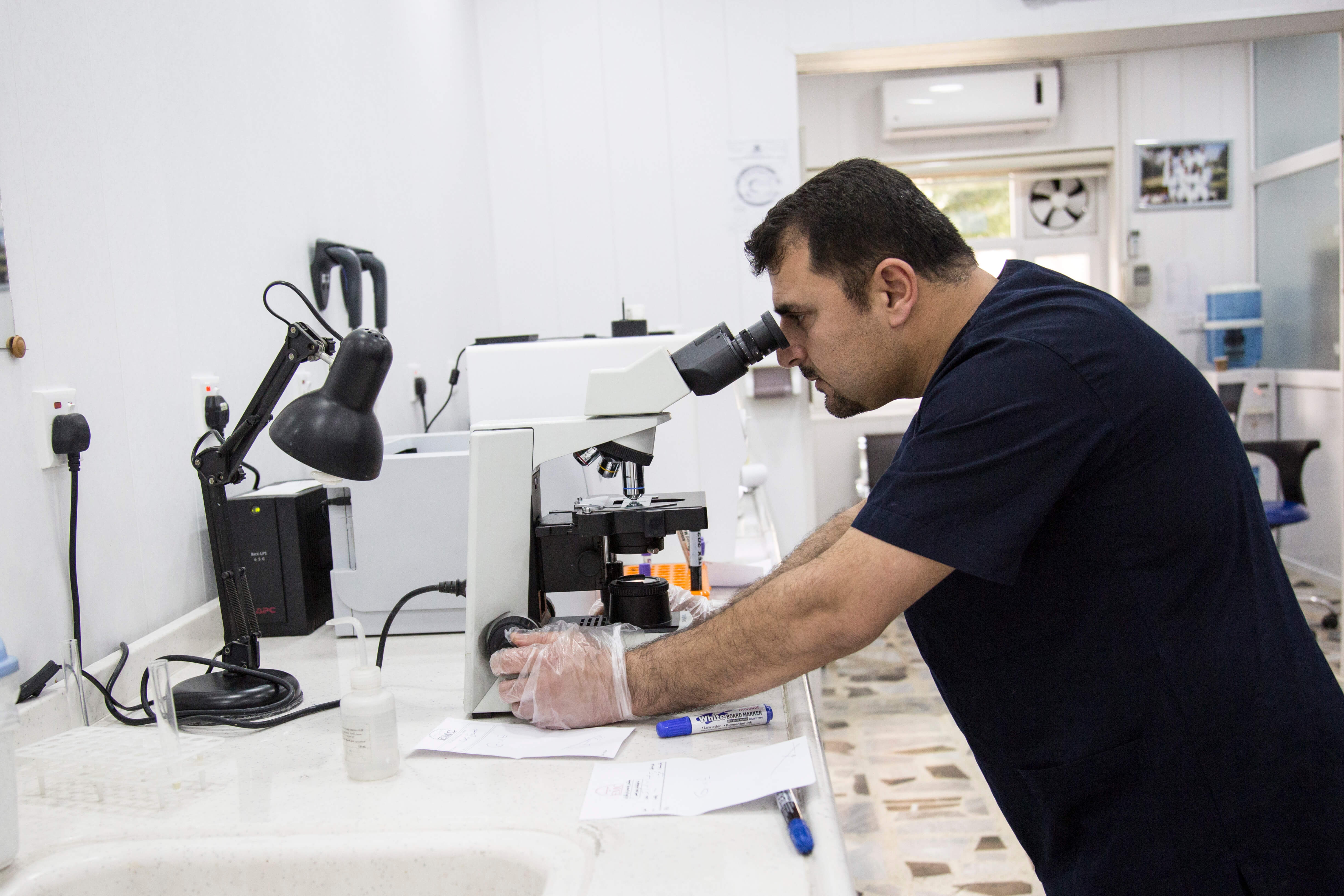
Over the past 40 years, the WHO laboratory manual for the examination and processing of human semen has become a vital guide for laboratory examinations, widely translated and used extensively by clinical and research laboratories throughout the world. The sixth edition of this important tool has now been published. It gives information on semen examination and preparation for clinical evaluation, assessment, cryopreservation, quality control in the semen analysis laboratory, and laboratory examination in the investigation of male sexual and reproductive health. The updated manual will help scientists, technicians, laboratory experts and health workers worldwide to safeguard the quality of research and clinical use of human semen in laboratory settings – ultimately improving sexual and reproductive health.
Access the manual: https://www.who.int/publications/i/item/9789240030787
Watch the webinar of the launch: https://www.youtube.com/watch?v=CMz64qxyBj8